What DR Congo’s Baleinières Reveal About Africa’s Maritime Infrastructure Problem
There is a boat moving through the Congo Basin that tells a much bigger story than its wooden hull suggests.
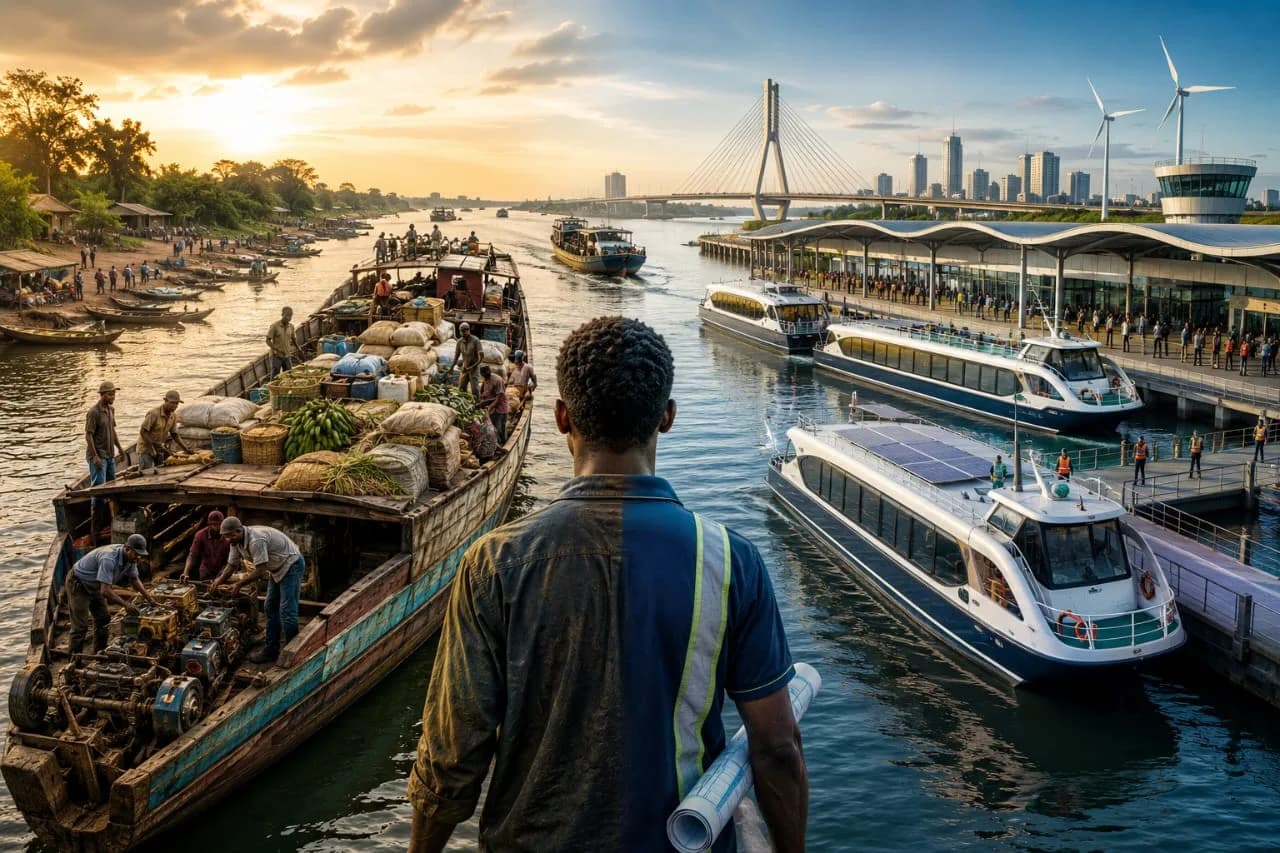
It carries food, traders, manufactured goods and passengers
between communities separated by rivers, forests and failing roads. It does not
depend on a modern terminal. It does not wait for a concrete jetty. It does not
require a sophisticated port complex before it can serve the economy around it.
It simply moves.
Built largely by local craftsmen, adapted over decades and
modified with inexpensive engines and locally acquired knowledge, the
baleinière has become one of the most consequential examples of grassroots
maritime innovation in the Democratic Republic of Congo.
And that raises an uncomfortable question for Africa:
What happens when people build the maritime system they need
faster than governments can build the infrastructure intended to provide it?
The answer is not that government is unnecessary. Nor is it
that informal systems are inherently superior.
The deeper lesson is more important.
Infrastructure does not become economically valuable simply
because an asset has been built. It becomes valuable when people, technology,
institutions, knowledge and physical infrastructure work together as a system.
That distinction could determine the success or failure of
Africa’s next generation of maritime investments.
The story of the baleinière is therefore not really a story
about wooden boats. It is a story about necessity, adaptation, infrastructure,
governance and the difference between building an asset and building a
functioning maritime system.
And Nigeria provides one of the most important places to ask
what that difference means.
THE BOAT THAT BECAME INFRASTRUCTURE
The Congo Basin contains one of Africa’s great natural
transportation systems.
Yet the existence of a river does not automatically create a
transport network.
Someone still has to build the vessels. Someone has to
navigate them. Someone has to load and unload cargo. Someone has to connect
producers to markets. Someone has to understand the changing river, its
channels, sandbanks, currents and seasonal rhythms.
In the Democratic Republic of Congo, much of that system
emerged from below.
The baleinières are locally developed wooden cargo vessels,
generally measuring between roughly 20 and 40 metres. Their contemporary form
grew from earlier boatbuilding traditions, Congolese craftsmanship and
adaptations introduced over several decades.
Their importance accelerated as conventional transport
infrastructure deteriorated and economic necessity intensified.
From the 1990s onward, these vessels became increasingly
important in connecting agricultural communities with river towns and major
urban markets.
Research by Peter Lambertz places their importance in
sharper perspective: baleinières account for at least half of the movement of
goods and people on the DRC’s inland waterways, according to his 2024
peer-reviewed research.
This is not a niche artisanal activity.
It is infrastructure.
Just not infrastructure in the conventional sense.
There are no massive procurement programmes behind the
entire network. There is no single master plan governing every route. There is
no central authority designing every landing point.
Instead, the system evolved through thousands of decisions
made by boatbuilders, mechanics, traders, passengers, crews and communities
responding to immediate economic realities.
The baleinière is therefore one of Africa’s most revealing examples of bottom-up infrastructure formation.
NECESSITY BECAME THE ENGINEER
The baleinière did not emerge because someone decided that
an innovative wooden vessel would become a strategic component of national
transport policy.
It emerged because people needed to move.
The decline of road connectivity fragmented the country into
increasingly disconnected economic territories. Agricultural communities still
produced food. Cities still needed food. Traders still needed to move goods.
Families still needed mobility.
The river remained.
So people adapted.
Local builders combined older boatbuilding knowledge with
available materials. Traditional techniques encountered colonial era carpentry.
Later, low cost
Chinese diesel engines entered the system.
Then another form of innovation occurred.
Local mechanics modified the propulsion arrangements.
Instead of treating a single engine as a potential point of failure, operators
could use multiple engines. If one failed, others could continue to propel the
vessel.
It was neither glamorous nor technologically sophisticated.
But it answered an important engineering question:
How do you keep an economically essential vessel moving when
maintenance resources are limited and stopping has a direct cost?
The answer was redundancy.
Not necessarily the expensive redundancy of modern
industrial systems, but practical redundancy developed from what was available.
That is the genius and the limitation of necessity driven
innovation.
It does not ask what the ideal system would look like.
It asks:
What can work here, with what we have, for the people who need it now?
THE MOST IMPORTANT INNOVATION MAY NOT BE THE BOAT
The most intellectually interesting part of the baleinière
story is not actually its wooden construction.
It is what happens around the boat.
The vessel can load and unload where conventional
infrastructure cannot.
Water levels change. Riverbanks shift. Markets move.
Agricultural production follows seasonal patterns. A fixed port cannot
necessarily follow all of that.
The baleinière can.
One of the practices documented in the Congo research is
kotindika — a technique in which porters enter shallow water and physically
push a loaded vessel into deeper water when it settles on the riverbed.
The vessels’ dugouts can also function as mobile gangways.
The people working on the boat can simultaneously become
part of its loading infrastructure.
The boat, in effect, carries part of its own port.
That is a profound infrastructure idea.
Modern transport thinking often defines infrastructure as
fixed physical assets:
A jetty.
A terminal.
A crane.
A road.
A warehouse.
A navigation beacon.
But the Congo example expands the definition.
Infrastructure can also be:
people + skills + technology + environmental knowledge +
operating practices + relationships.
This matters because much of Africa’s infrastructure
challenge is not simply the absence of physical assets.
It is the difficulty of making those assets function within the economic and social environment around them.
INFRASTRUCTURE THAT FOLLOWS THE ECONOMY
The baleinière network does something many formal transport
systems struggle to do:
It takes transport to where the economy actually is.
Agricultural communities produce rice, cassava, palm oil,
fish, livestock and other goods.
Urban consumers need those products.
Traders need to move between both ends.
Manufactured goods need to travel back to rural communities.
The boat becomes the connection between these economic
worlds.
Because the vessel is not tied to a single large terminal, a
network of informal landing points and temporary markets can emerge.
Markets can appear, disappear and shift.
Routes can adapt.
The system responds to production cycles and purchasing
power.
This is not an argument that informal systems should replace
planned infrastructure.
It is an argument that successful infrastructure understands
the behaviour of the economy it is designed to serve.
That distinction is frequently lost in infrastructure
planning.
A road can be beautifully engineered and still fail to
connect the right economic nodes.
A terminal can be constructed and remain underutilised.
A vessel can be purchased and become stranded because
maintenance, routes, financing, passenger demand or supporting infrastructure
were not properly considered.
An asset can exist without a system existing around it.
The baleinière illustrates the reverse.
The system existed because the users needed it to exist.
BUT NECESSITY IS A TERRIBLE ENGINEER TOO
There is a danger in romanticising this story.
The fact that the baleinière system works does not mean it
works well enough.
People die.
The same flexibility that allows the vessels to operate
without conventional infrastructure can also make safety enforcement difficult.
Economic urgency can push operators towards overloading,
insufficient rest, inadequate maintenance and dangerous operating practices.
Training competes with the need to keep earning.
Safety investments compete with thin margins.
Night travel may be dangerous, but for a trader who must
make a living, eliminating night journeys can mean losing a significant part of
the trading cycle.
This is the paradox at the centre of the Congo system:
The same characteristics that make it economically resilient
can make it difficult to regulate safely.
That is why the correct lesson is not:
Informal is better.
It is:
Informal systems often contain valuable knowledge that
formal systems ignore while also containing risks that formal systems are
designed to address.
Africa needs both lessons.
The objective should therefore not be to formalise every
local system until it loses its flexibility.
Nor should governments simply leave communities to fend for
themselves.
The challenge is to build a bridge between the two.
WHEN REGULATION MEETS REALITY
This is where Lambertz’s research becomes particularly
important.
One of the most revealing episodes concerns navigation
infrastructure on the Lomami River.
Internationally supported efforts introduced navigation
markers and buoys around a dangerous passage.
On paper, the intervention made perfect sense.
Mark the hazard.
Make navigation safer.
Reduce accidents.
But the local river economy already had a system.
Local fishermen had spent decades acting as guides through
the dangerous passage. Their knowledge was itself a form of navigation
infrastructure.
The new markers threatened not simply a navigational
practice, but a livelihood.
The markers disappeared.
The episode demonstrates something infrastructure planners
frequently underestimate:
A technically correct intervention can still be contextually
wrong.
The problem was not necessarily the idea of navigation
markers.
The problem was introducing a new system without
sufficiently understanding the system that already existed.
Lambertz’s research captures this tension through the idea
of the “revenge of contexts.”
A solution designed for one environment can produce
unexpected consequences when transferred into another.
This is not uniquely Congolese.
It is an African infrastructure problem.
Projects are often evaluated through engineering, financing,
procurement and construction.
But infrastructure also lives inside cultures, livelihoods,
informal economies, political relationships and local knowledge systems.
Those realities do not disappear because a project has been
approved.
NIGERIA HAS THE INFRASTRUCTURE AMBITION
This is where the Congo story becomes particularly relevant
to Nigeria.
Nigeria is not starting from the same position.
It has formal institutions. It has the National Inland
Waterways Authority (NIWA). It has regulatory structures, dredging programmes,
hydrographic surveys, jetties, river ports, navigation projects, search-and-rescue
infrastructure and formal investment plans.
Nigeria’s Federal Ministry of Marine and Blue Economy has
identified inland waterway development as part of its broader maritime
strategy, while NIWA has positioned the development of safe, seamless and
affordable inland-waterway transportation as part of its mandate.
The scale of the ambition is considerable.
NIWA’s 2026 budget plans included more than ₦16 billion for
inland waterway related projects, including vessel acquisition, dredging, wreck
removal and jetty and ramp construction. The programme also includes dredging
of approximately 1,000 kilometres of navigable waterways.
Earlier project pipelines have included hydrographic
surveys, navigation buoys, search and rescue stations, river port development,
dredging and waterway environmental management.
Nigeria is therefore not suffering from an absence of formal
infrastructure thinking.
Quite the opposite.
The country is trying to build a modern inland-waterway
system.
And that is precisely why the Congo comparison is useful.
The question is no longer:
Should Nigeria invest in formal infrastructure?
It absolutely should.
The more important question is:
Can Nigeria turn infrastructure investment into an operating system that responds to how people actually move, trade and live?
THE ASSET IS NOT THE SYSTEM
This may be the most important distinction Africa needs to
make.
A boat is an asset.
A functioning ferry network is a system.
A jetty is an asset.
A reliable water-transport corridor is a system.
A dredged channel is an asset.
A navigable route with reliable marking, maintenance,
rescue, regulation and commercial demand is a system.
An electric ferry is an asset.
An integrated passenger service with terminals, charging
infrastructure, routes, ticketing, maintenance, scheduling, safety and paying
passengers is a system.
Government can procure the first. It has to build the
second.
This is where Nigeria’s next generation of waterway investment will be tested.
OMI ÈKÓ: THE RIGHT IDEA, THE BIGGER TEST
Consider Lagos’ Omi Èkó project.
The programme is designed around a modern vision of inland
water transport: approximately €411 million in total funding, 15 ferry routes,
140 kilometres of dredged and marked waterways, 25 ferry terminals and jetties,
and a fleet of 78 electric vessels supported by intelligent transport systems
and charging infrastructure.
It is exactly the kind of investment required if Lagos is
serious about shifting part of its transportation burden from roads to water.
It would therefore be a mistake to interpret the Congo
experience as an argument against this kind of project.
It is not.
In fact, Omi Èkó demonstrates what formal infrastructure can
accomplish that a grassroots system cannot easily provide:
structured safety standards;
predictable passenger services;
modern vessels;
environmental benefits;
formal terminals;
intermodal connectivity;
integrated ticketing;
professional operations;
maintenance systems;
and institutional accountability.
But there is a deeper question.
Will the infrastructure behave like a system?
Will the routes reflect actual travel patterns?
Will ferry schedules match working people’s needs?
Will fares be affordable enough to create sustained demand?
Will maintenance financing remain available after the
launch?
Will charging infrastructure remain functional?
Will operators understand the local passenger economy?
Will waterways remain navigable?
Will safety enforcement be consistent?
Will communities that already use the waterways see the
formal network as an expansion of opportunity or as a system designed around
them rather than with them?
These questions are not peripheral.
They are the difference between infrastructure and infrastructure that works.
NIGERIA’S WATERWAY PROBLEM IS NOT ONLY A CAPITAL PROBLEM
There is another reason the Congo comparison matters.
Nigeria can spend money on waterways and still have unsafe
water transport.
The evidence is painfully current.
In August 2026, an overloaded boat capsized in Sokoto State
while carrying people travelling to farms. Dozens of people died, with reports
putting the death toll at more than 50 as recovery operations continued.
The tragedy was not simply a story about a boat.
It exposed a systems problem:
People still depend on water transport because they need to
reach economic activity.
Safe vessels are not always available.
Regulatory enforcement remains difficult.
Weather and seasonal conditions matter.
And economic necessity can overwhelm formal safety
requirements.
This is where Nigeria and Congo unexpectedly meet.
Congo’s baleinières emerged because communities could not
wait for formal infrastructure.
Nigeria has formal institutions, but some communities still
cannot wait for formal infrastructure to reach them.
That distinction is crucial.
Africa can have formal maritime governance and informal
maritime dependence at the same time.
The existence of government infrastructure does not automatically eliminate the economic forces that created informal systems.
THE REAL COMPETITION IS NOT FORMAL VS INFORMAL
This is perhaps the wrong binary.
The Congo experience challenges the assumption that the
state is always the source of formal infrastructure while local operators exist
outside it.
Lambertz’s research shows something more complicated.
Government officials, boat operators, local communities and
economic actors continuously negotiate with one another.
The state is present, but its presence is uneven.
Local actors are not simply resisting government. They are
also interacting with it, adapting to it and sometimes appropriating its
standards.
The informal economy is not necessarily a separate universe.
It can become part of the machinery through which the state
actually functions.
This matters enormously for Nigeria.
The question should not be:
How do we eliminate informal water transport?
It should be:
How do we bring the knowledge and economic reach of local operators into a safer, more productive formal system?
That is a much more intelligent policy question.
AFRICA’S MISSING INFRASTRUCTURE MAY BE BETWEEN THE ASSETS
Ports have expanded.
Roads have been built.
Railways are being modernised.
Airports have been upgraded.
Ferries are being procured.
River ports are being developed.
But the hardest infrastructure to build may be the
infrastructure between these assets.
The coordination.
The maintenance.
The data.
The operating model.
The financing.
The skills.
The safety culture.
The last-mile connection.
The relationship between a farmer and a river port.
Between a ferry terminal and a bus route.
Between a dredged channel and a reliable service.
Between a boatbuilder and a regulator.
Between a public investment and a commercial operator.
This is where infrastructure becomes a system.
And it is also where many projects become vulnerable.
WHAT NIGERIA CAN LEARN WITHOUT COPYING CONGO
Nigeria should not import the baleinière model.
It should extract its underlying intelligence.
1. Design around actual economic behaviour
Infrastructure should begin with a question more fundamental
than:
What can we build?
It should ask:
What are people already trying to do?
Where do farmers need to move goods?
Where do traders travel?
Where are communities isolated from roads?
Where do passengers already use water?
Where do informal landing points emerge?
Those patterns should inform formal infrastructure.
2. Treat local knowledge as infrastructure
A river pilot’s knowledge is an asset.
A boatbuilder’s experience is an asset.
A trader’s understanding of seasonal demand is an asset.
A community’s knowledge of water levels and local hazards is
an asset.
Formal infrastructure should not erase these capabilities.
It should organise, strengthen and make them safer.
3. Build modularity into maritime systems
The baleinière’s propulsion adaptations reveal a broader
engineering principle:
Systems operating in difficult environments need resilience,
not merely sophistication.
For Nigeria, this can extend beyond engines.
Can maintenance systems be decentralised?
Can spare parts be locally available?
Can smaller vessels be repaired closer to their operating
communities?
Can boatbuilding capacity be strengthened domestically?
Can safety equipment be designed around the realities of smaller
operators?
Modernisation does not always require centralisation.
4. Make safety economically possible
Telling an operator not to overload a vessel is necessary.
But enforcement alone may not solve the underlying problem
if the operator’s economics make compliance impossible.
Safety has to become part of the business model.
That means access to financing, affordable insurance, reliable vessels, training, life-saving equipment, navigation information, search and rescue, maintenance and critically commercially viable routes.
A safe boat that cannot make money will not necessarily
remain in service.
5. Build the navigation system, not merely the channel
Dredging is important.
But a dredged channel is not a complete transport system.
Nigeria needs the supporting architecture:
hydrographic information;
navigation markers;
water-level monitoring;
weather information;
maintenance;
wreck removal;
search and rescue;
communications;
and reliable enforcement.
The Congo experience demonstrates why environmental
knowledge and navigation practices must be incorporated into this architecture.
6. Use local boatbuilding as an industrial opportunity
Nigeria has indigenous boatbuilding talent.
The opportunity is not simply to preserve traditional craftsmanship.
It is to upgrade it.
Local builders could be integrated into modern standards, materials, certification, design, maintenance and production.
That could create an industrial ecosystem around inland water transport rather than making the country perpetually dependent on imported vessels.
The goal should be simple:
local capability with modern standards.
THE BLUE ECONOMY DOES NOT BEGIN AT THE PORT
This may be the biggest lesson of all.
Africa’s blue economy is often discussed through large
assets:
deep-sea ports;
shipping;
offshore energy;
fisheries;
shipbuilding;
maritime services.
All of these matter.
But there is another layer beneath them.
The farmer who gets produce to the river.
The trader who moves it to a town.
The boat operator who carries it downstream.
The market that receives it.
The truck that takes it onward.
The port that connects it to another country.
The maritime system is only as strong as the connections between these points.
This is why a wooden boat in the Congo Basin can tell us something about Africa’s blue economy.
The boat is not the blue economy.
The network around the boat is.
THE REAL AFRICAN MARITIME INFRASTRUCTURE QUESTION
Africa does not lack ideas.
It does not lack rivers.
It does not lack coastline.
It does not lack entrepreneurial communities.
It does not lack engineers.
It does not lack development partners.
It does not even necessarily lack capital.
The harder problem is translating these resources into systems that continue to work after the ribbon-cutting ceremony.
That requires a different philosophy of infrastructure.
One that recognises that:
A project is not a system.
A vessel is not a service.
A terminal is not a transport network.
A dredged river is not a navigable economy.
A regulation is not safety unless it can actually be
implemented.
And perhaps most importantly:
A government does not build maritime capacity simply by
building maritime assets.
Capacity emerges when those assets become embedded in the economic, technological, institutional and human systems around them.
FROM NECESSITY TO CAPABILITY
The great irony of the baleinière is that it represents both Africa’s ingenuity and Africa’s failure.
It represents ingenuity because communities transformed local materials, traditional knowledge, imported low cost technology and practical experience into a transport network capable of moving people and goods across an enormous river system.
It represents failure because people had to build this
system partly because formal connectivity had deteriorated.
It works.
But it should not have had to carry so much responsibility.
That is the distinction Africa must understand.
The lesson is not to leave communities to solve infrastructure problems themselves.
The lesson is to understand how communities solve problems when formal systems fail and then build formal systems that learn from that intelligence.
That is the opportunity before Nigeria.
Nigeria has something the baleinière economy did not have at
its origin:
capital;
institutions;
regulatory authority;
international financing;
engineering capacity;
digital technology;
large urban markets;
and the ability to plan at national scale.
But those advantages only matter if they produce operational systems.
The future of Nigerian inland water transport will therefore not be determined by how many boats are purchased.
It will be determined by whether those boats become part of reliable networks.
Not by how many jetties are constructed.
But by whether passengers can actually use them conveniently.
Not by how many kilometres are dredged.
But by whether the waterways remain safely navigable.
Not by how many regulations are issued.
But by whether operators can comply and enforcement can be sustained.
Not by how much money is committed.
But by what economic capability that money creates.
BUILDING THE HYBRID AFRICAN MARITIME SYSTEM
The answer may ultimately lie neither in the Congo model nor entirely in the conventional state model.
It lies somewhere between them.
Government must provide what communities cannot efficiently
provide at scale:
standards, safety, navigation, hydrography, dredging, rescue, regulation, data and long-term infrastructure.
Local communities provide what central institutions often
cannot easily manufacture:
knowledge, adaptability, route intelligence, technical craftsmanship, social trust and intimate understanding of economic behaviour.
Private capital can provide:
investment, technology, maintenance, commercial discipline
and innovation.
Research institutions can provide:
evidence, measurement and the ability to understand what is actually happening on the water.
Together, these can produce something more resilient than
either extreme:
a formal system with local intelligence;
a modern system with contextual knowledge;
a regulated system that understands the economy it
regulates;
a government backed system that does not treat the communities using it as obstacles to be managed.
That is what Africa’s maritime infrastructure should become.
THE BOAT IS ASKING A BIGGER QUESTION
There is something almost paradoxical about the baleinière.
A wooden vessel developed in conditions of economic hardship has managed to become a technological backbone of an enormous inland transport economy.
It is affordable.
It is adaptable.
It is repairable.
It can operate where conventional infrastructure is absent.
It responds quickly to demand.
But it also exposes the human cost of infrastructure failure.
People travel because they must.
Goods move because livelihoods depend on them.
Operators take risks because economic survival leaves little room for delay.
That is why the baleinière should not be presented as a romantic symbol of African ingenuity.
It should be treated as a warning.
When people are forced to build their own infrastructure, they will innovate.
But they will also inherit risks that a functioning state should help absorb.
The responsibility of government is therefore not to crush that innovation in the name of formalisation.
It is to turn it into capability.
FROM ASSETS TO SYSTEMS
This is the challenge facing Nigeria and much of Africa.
The continent is entering another major infrastructure cycle.
Billions will be spent on ports, roads, railways, ferries, terminals, logistics corridors, digital systems and maritime assets.
The question that should accompany every investment is
therefore not simply:
What are we building?
It should be:
What system will this become?
Who will use it?
How will they use it?
What happens when demand changes?
Who maintains it?
What local knowledge already exists?
What informal systems are already performing the function?
What economic incentives will make the formal system viable?
What happens when the government project meets the realities
of the community?
What happens after the financier leaves?
What happens after the contractor completes the project?
What happens five years later?
These are not secondary questions.
They are the questions that determine whether infrastructure becomes productive capacity.
THE PRIMEAXIS INSIGHT
The story of DR Congo’s baleinières begins with a wooden boat.
But it ends with a much bigger question about how Africa builds.
Necessity created a maritime system because people could not afford to wait for infrastructure to arrive.
They used what they had.
They adapted what they could obtain.
They combined local knowledge with imported technology.
They created infrastructure from people, skills and the
environment around them.
They built a network because they needed an economy to move.
But necessity also imposed a price.
Safety suffered.
Regulation struggled.
Maintenance competed with survival.
Human beings absorbed risks that a stronger infrastructure
system should have absorbed.
That is where the lesson for Nigeria becomes clear.
Africa does not need to choose between grassroots ingenuity and formal infrastructure. It needs to connect them.
The future should not belong to infrastructure designed
without the people who will use it.
Nor should it belong to informal systems forced to carry the burden of national connectivity without adequate safety, finance or institutional support.
The ambition should be greater:
to build formal maritime systems with the adaptability of necessity,
the discipline of engineering and the protection of effective governance.
Nigeria’s inland waterways offer precisely that opportunity.
The country is already investing in dredging, vessels, jetties, navigation, safety infrastructure and modern ferry systems. Projects such as Omi Èkó demonstrate that the ambition to build sophisticated waterborne transport exists.
The next question is whether these investments can become more than collections of assets.
Can they become living systems?
Systems that understand their users.
Systems that respond to economic behaviour.
Systems that incorporate local knowledge.
Systems that remain operational after the launch ceremony.
Systems that make safety economically possible.
Systems that connect rural production to urban markets.
Systems that integrate water with road, rail, ports and trade.
And ultimately, systems that turn Africa’s extraordinary waterways into productive economic infrastructure rather than simply geographical features.
That is the real lesson of the baleinière.
The most successful infrastructure is not necessarily the infrastructure that looks most impressive.
It is the infrastructure that works.
And Africa’s next maritime advantage may come from learning how to make its formal infrastructure work with the same urgency, adaptability and economic intelligence that necessity has already taught its people.
RESEARCH & REFERENCES
- Peter Lambertz, “Baleinières’ Riverine Environment and the Materiality of Infrastructure in the Democratic Republic of Congo” (2024), peer-reviewed research on the material, technological, environmental and social dimensions of the baleinière economy.
- Peter Lambertz, research on Congo River transport, artisanal infrastructure, local knowledge, navigation and the interaction between formal interventions and existing river economies.
- The Conversation, 23 August 2026, “DR Congo’s riverboat economy: how a floating transport system tells the country’s story.”
- Nigerian Federal Ministry of Marine and Blue Economy inland waterway development and broader blue economy policy materials.
- National Inland Waterways Authority (NIWA) inland waterway development, dredging, navigation, safety and infrastructure investment documents.
- Omi Èkó Lagos Water Transport Project financing, electric ferry fleet, routes, terminals, dredging and intelligent transport-system architecture.
- Recent Nigerian reporting and official statements on inland waterway safety, including the August 2026 Sokoto state boat tragedy.
- Research and policy literature on African maritime infrastructure, inland connectivity, local knowledge, informal economies and the relationship between physical infrastructure and economic systems.