
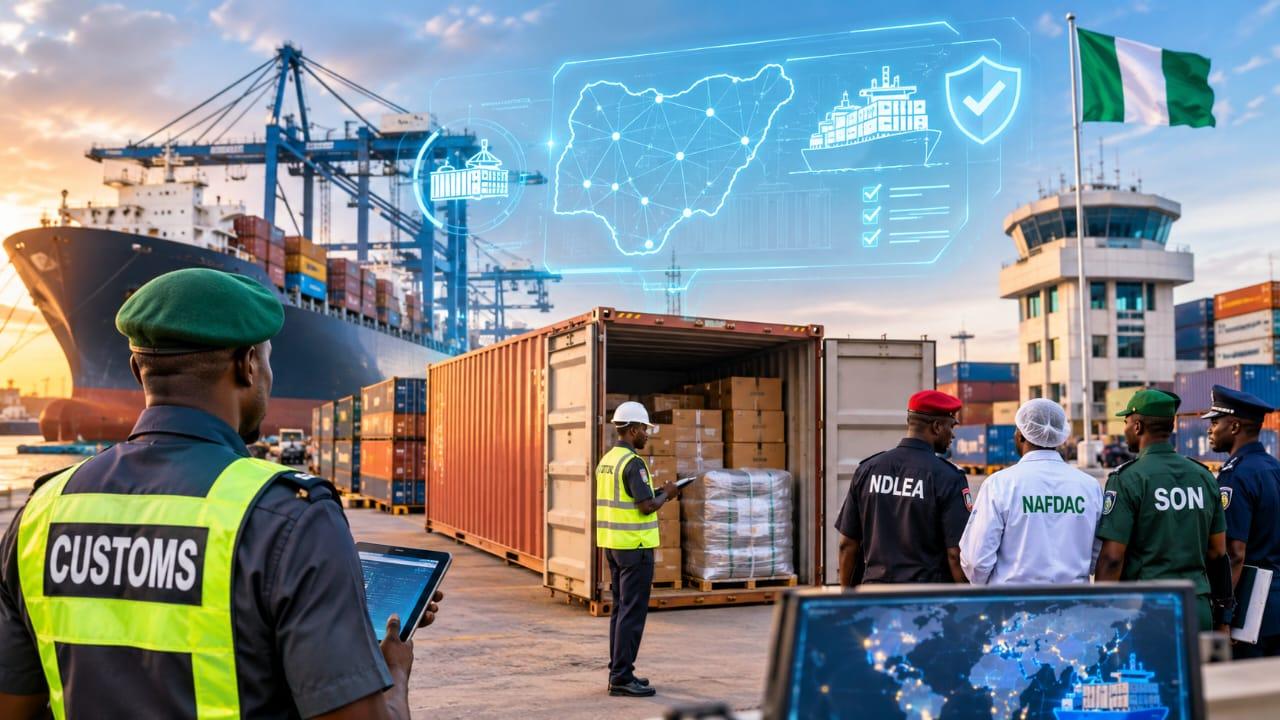
Nigeria's ports are critical gateways through which goods enter the country's economy, industries receive essential supplies and international trade is conducted. Every vessel arrival represents the movement of cargo with implications for government revenue, national security, consumer protection and economic activity. Yet an important question remains: how effectively can Nigeria identify, verify and monitor the goods entering its ports, and how well do the institutions responsible for controlling these movements share the information required to do so?
The issue goes beyond the physical inspection of containers. It concerns the country's ability to obtain accurate cargo information before vessels arrive, assess potential risks, identify discrepancies in declarations, track consignments and coordinate enforcement among agencies with different statutory responsibilities.
Nigeria has several institutions operating within its port environment. However, having multiple agencies does not automatically translate into an effective, coordinated cargo intelligence system. The critical issue is whether information held by one institution can be accessed and acted upon by another when necessary.
At the centre of cargo administration is the Nigeria Customs Service (NCS), responsible for customs control, revenue collection, enforcement and the administration of goods entering and leaving the country. Its responsibilities intersect with those of the Nigerian Ports Authority (NPA), which manages port infrastructure and operations, and the Nigerian Maritime Administration and Safety Agency (NIMASA), which has responsibilities relating to maritime safety, security and shipping regulation.
Other institutions, including the National Drug Law Enforcement Agency (NDLEA), National Agency for Food and Drug Administration and Control (NAFDAC), Standards Organisation of Nigeria (SON), Nigeria Agricultural Quarantine Service and Nigeria Immigration Service, perform additional regulatory and enforcement functions.
Each institution holds information relevant to particular aspects of cargo movement. Customs receives declarations and processes cargo documentation. Shipping lines maintain vessel and manifest information, while terminal operators manage the physical handling and movement of containers. Other agencies require access to relevant information to determine whether particular goods comply with regulatory requirements or present security risks.
The effectiveness of this arrangement depends on how well these different sources of information connect.
WHAT THE TIN CAN ISLAND STUDY REVEALS
The Nigeria Customs Service's Time Release Study at Tin Can Island Port offers important evidence of the coordination challenges within Nigeria's port environment.
Conducted between February and May 2024 with technical support from the World Customs Organization, the study examined the stages involved in cargo processing, from vessel arrival and documentation to inspection and final exit from the port. Its findings were officially launched in January 2026.
One of its significant findings was that vessel arrival information was not captured through a single integrated platform accessible to all relevant stakeholders. Port authorities, shipping lines, terminal operators, Customs and other border agencies largely operated through separate systems and procedures, with limited real time information exchange.
This fragmentation affected the transmission of arrival information, created duplicated processes and contributed to uncoordinated workflows.
The quantitative assessment used 601 validated declarations. For 98.7 per cent of the consignments examined, the average time between booking for examination and physical exit from the port was three days, 14 hours and 34 minutes. Eight consignments, representing 1.3 per cent of the sample, experienced exceptionally prolonged clearance periods exceeding two months.
Perhaps more revealing was the limited use of non intrusive inspection technology. Fewer than one per cent of the consignments in the study were routed for scanning, with only five consignments recorded in that category.
Approximately 99 per cent underwent physical examination.
The findings also identified the absence of coordinated joint inspections among border agencies, frequent system interruptions, manual documentation processes and delays associated with cargo evacuation.
Although the study primarily examined cargo clearance efficiency, its findings raise a wider institutional question. If the systems used by different port stakeholders are not sufficiently connected to establish a coordinated picture of cargo movements, how effectively can the country identify and respond to emerging cargo risks?
SECURITY CANNOT DEPEND ON SEIZURES ALONE
Nigeria's exposure to illicit trade makes effective cargo intelligence an important national security requirement.
Seaports can be exploited by criminal networks seeking to move narcotics, prohibited goods, undeclared merchandise and other illicit consignments across international borders. The consequences extend beyond the immediate security threat to include revenue losses, damage to legitimate businesses and increased costs for enforcement agencies.
The detection and seizure of prohibited goods demonstrate the work of enforcement institutions. However, seizure figures alone cannot establish the overall effectiveness of a country's cargo control arrangements. They do not reveal how much illicit cargo may have escaped detection or whether intelligence is being used effectively to identify suspicious shipments before they enter domestic supply chains.
There are, however, signs of institutional efforts to strengthen intelligence cooperation.
In April 2026, the NDLEA and Nigeria Customs Service signed a collaborative framework designed to improve intelligence sharing and joint enforcement against drug trafficking and organised crime.
The agreement provides for a structured and secure platform for exchanging actionable intelligence, joint task forces at critical operational points and a standing inter agency committee to resolve operational disagreements. It also covers closer cooperation across seaports, airports and land borders.
This is an important development. But the effectiveness of such arrangements will depend on implementation, operational discipline and the extent to which intelligence sharing becomes part of routine enforcement rather than remaining an institutional commitment.
An effective cargo intelligence framework requires more than physical inspection. It depends on risk profiling, reliable documentation, information sharing, appropriate scanning infrastructure and the ability of relevant agencies to act on intelligence in a coordinated manner.
Technology is important, but acquiring scanners and deploying digital platforms cannot independently resolve institutional weaknesses.
Equipment must be operational, personnel must be properly trained, and information generated through inspections must reach the agencies responsible for enforcement and regulatory decisions.
The objective should be to identify high risk consignments without subjecting every legitimate shipment to unnecessary delays and repeated inspections.
THE NATIONAL SINGLE WINDOW AND THE INTEGRATION CHALLENGE
Nigeria's National Single Window initiative represents an important attempt to address fragmentation in trade documentation and regulatory processes.
Launched operationally on March 27, 2026, the platform is designed to provide a centralised electronic entry point through which importers and exporters can submit regulatory documentation and interact with participating government agencies.
Its performance figures up to October 2026 indicate that 169,211 licences, permits and other regulatory documents had been processed. The platform had registered 12,465 importers and agents, onboarded 27 airlines and integrated 56 shipping lines. It had also processed 4,009 air cargo manifests and 405 sea cargo manifests.
These figures demonstrate growing adoption of the platform and progress towards digitising trade related procedures.
However, the distinction between a digital trade documentation platform and a fully integrated cargo intelligence system remains important.
The National Single Window can improve the submission and transmission of information, reduce repeated documentation and make regulatory processes more efficient. But its wider value will depend on the extent to which participating institutions can use shared information to strengthen risk assessment, coordinate inspections and improve cargo monitoring.
As of November 2026, the Nigerian Ports Authority and NIMASA were identified as institutions expected to be onboarded as part of the next integration milestone. Their proposed inclusion would expand the maritime component of the platform.
This makes the next stage particularly significant. Maritime trade involves several regulatory and operational processes, and the integration of institutions responsible for port operations and maritime administration could strengthen the information available across the system.
The challenge is to ensure that digital integration translates into operational integration. Connecting institutions electronically is one achievement. Ensuring that they share relevant intelligence, coordinate decisions and respond effectively to identified risks is another.
WHO IS ACCOUNTABLE WHEN INFORMATION FAILS TO CONNECT?
Nigeria does not necessarily need another agency to oversee cargo movements. What it needs is a more effective framework for ensuring that existing institutions fulfil their responsibilities through coordinated information sharing and clearly defined operational procedures.
When suspicious cargo is identified, relevant agencies should be able to access the information required to investigate and respond.
When discrepancies emerge between cargo declarations and inspection findings, the process for notifying the appropriate authorities should be clear. Where multiple agencies are required to inspect a consignment, their activities should be coordinated to prevent unnecessary duplication.
There must also be measurable indicators of institutional performance. How many high risk consignments are identified before arrival? How quickly is intelligence communicated to the relevant agencies? How many inspections are conducted jointly? How effectively are identified risks followed through to enforcement outcomes?
These questions should form part of the government's assessment of port security and trade facilitation reforms.
For importers, exporters, shipping companies and terminal operators, fragmented information systems can translate into additional costs, repeated inspections and unpredictable clearance procedures. For government, the consequences may include revenue leakages, enforcement weaknesses and reduced confidence in the country's ability to regulate international trade.
Cargo intelligence is therefore not exclusively a security matter. It is also central to trade competitiveness, revenue protection and the credibility of Nigeria's maritime administration.
PRIMEAXIS INSIGHT
Nigeria's ability to control what enters its ports must be measured by more than the number of agencies stationed at its terminals, the equipment acquired or the volume of cargo processed. It must be measured by the quality of information available to the institutions responsible for protecting the country's economic and security interests.
The National Single Window offers an opportunity to improve information exchange, but its success must extend beyond documentation and administrative convenience.
The real test is whether Nigeria can establish a more connected system in which cargo information supports timely risk assessment, coordinated inspections and effective enforcement.
As the country invests in port modernisation and digital trade facilitation, the intelligence infrastructure supporting these investments deserves equal attention.
Ultimately, Nigeria must be able to answer a fundamental question: when a vessel arrives carrying thousands of containers, do the relevant authorities have the information, coordination and operational capacity to establish what is entering the country, identify what requires scrutiny and ensure that nothing prohibited passes through simply because critical information failed to connect?