
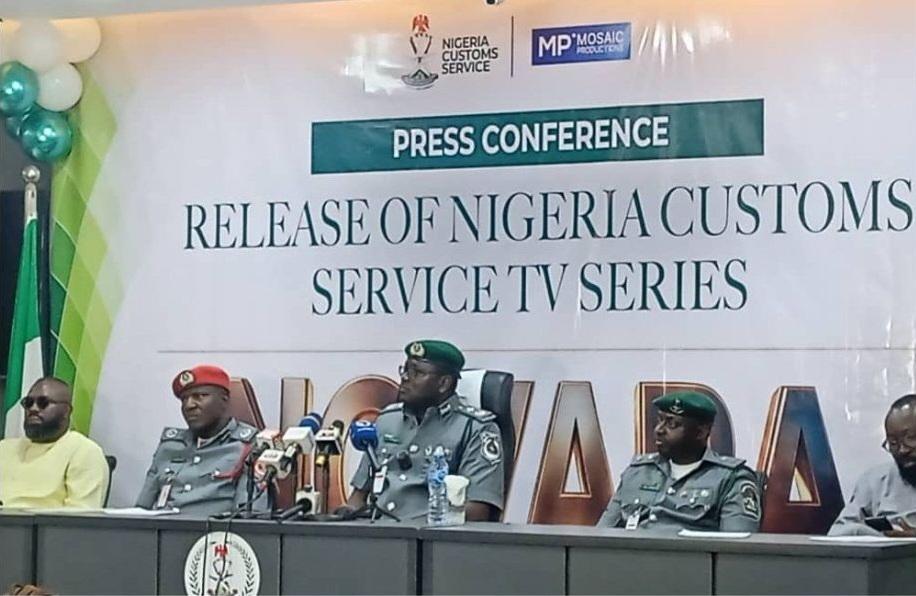
The Nigeria Customs Service (NCS) is turning to television drama to reshape public understanding of its operations, using a 79-episode production to bring the personal experiences, professional risks and sacrifices behind the Customs uniform to a wider audience.
Unveiled in Lagos on Tuesday, November 24, 2026, Novara marks a new direction in the Service's institutional communication strategy, moving beyond conventional press briefings, enforcement statistics, revenue announcements and policy updates to explore the human experiences behind its responsibilities.
The series is scheduled to premiere on Africa Magic Showcase on January 7, 2027. Its first season, comprising 39 episodes, has been completed and is ready for broadcast, while the remaining 40 episodes are still in production.
Speaking at the unveiling, the NCS spokesperson, Deputy Comptroller of Customs Abdullahi Aliyu Maiwada, PhD, MNIPR, said the initiative was conceived to bring the realities of Customs operations closer to Nigerians and international audiences.
He explained that although the Service is widely recognised for its responsibilities in revenue generation, trade facilitation and border security, the personal sacrifices, difficult decisions and operational challenges confronting its officers often receive less attention.
According to Maiwada, public perceptions of Customs have sometimes been shaped by isolated encounters and incomplete understanding of its responsibilities. He said the series would provide an opportunity to present these experiences from a human perspective while promoting integrity, courage, professionalism, patriotism and resilience.

DUTY, FAMILY AND THE REALITIES OF NATIONAL SERVICE
At the centre of Novara is Panshak, a Customs officer caught between his responsibility to protect his family and his professional obligation to defend the country against economic sabotage and transnational criminal activities.
The storyline follows his involvement in an undercover operation targeting an organised criminal cartel engaged in smuggling illicit drugs and arms into Nigeria. The syndicate, led by a notorious drug lord, John Bala, operates in collaboration with a Mexican drug network with links to the United States.
Working with colleagues in the Customs Intelligence Unit, Panshak embarks on a high-risk operation to expose and dismantle the criminal network. As the assignment progresses, however, the threat extends to his family, placing him under increasing pressure to reconcile his professional obligations with his responsibilities at home.
Through this narrative, the production explores the emotional burdens and personal consequences that can accompany security and law enforcement work. It also draws attention to the dangers of drug trafficking, arms smuggling and organised crime, alongside the importance of intelligence-led operations, inter-agency cooperation and institutional vigilance.
Although presented as fiction, Customs says the storyline draws inspiration from operational realities associated with the Service and the wider national security community.
The production brings together professionals from Nigeria's film and television industry. Produced by Agozie Ugwu and Roger Ofime, the series was filmed in Lagos, Nigeria, and Los Angeles, United States.
The first season features Tope Olowoniya, Ray Adeka, Sharon Rotimi, Charles Ukpong, Similayo Hassan and Yewande Osemen, alongside other actors. Daniel Orahi and Ben Chiadika directed the production.
PRIVATE-SECTOR PARTNERSHIP AND PRODUCTION ARRANGEMENTS
The Customs Service disclosed that Novara is being executed through a public-private partnership arrangement, with its contribution primarily in kind rather than through direct cash financing of the production.
Maiwada said the Service provided institutional support, including access to operational locations, facilities, vehicles, costumes, uniforms and props, as well as supporting actors drawn from its personnel.
Mosaic Theatre Production and Native Media provided the professional expertise required for script development, creative conceptualisation, filming and post-production. Native Media also contributed cameras and other technical production equipment.
Corporate organisations acknowledged for supporting the project include SIFAX Group, ASR Africa Foundation, BUA Group, Dufil Prima Foods, Air Peace, Red Star Express, Mikano International, Mobil and Guinness Nigeria.
Trade Modernization Project Limited (TMPL), JMG and West African Ventures were identified as organisations involved in ongoing sponsorship considerations.
Maiwada said the arrangement demonstrated how public institutions could leverage private-sector partnerships to execute communication initiatives without placing the entire financial burden on public resources.
He also acknowledged the contributions of the production partners, corporate sponsors and individuals involved in bringing the project to fruition.
Ahead of its television premiere, private screenings and preview engagements had been held in Lagos, Port Harcourt, Abuja and Kaduna.
The series will premiere on Africa Magic Showcase on Thursday, January 7, 2027. Subsequent episodes will air every Thursday and Friday at 9 a.m., with repeat broadcasts scheduled for Mondays and Tuesdays.
A DIFFERENT APPROACH TO INSTITUTIONAL COMMUNICATION
The unveiling reflects the Customs Service's intention to expand how it communicates its responsibilities, policies and contributions to national development.
Maiwada said traditional communication channels remained important but argued that creative storytelling offered additional opportunities to present complex institutional issues in ways that audiences could relate to and remember.
He described the project as part of the broader vision of the Comptroller-General of Customs, Bashir Adewale Adeniyi, MFR, and the Service's management team to embrace innovation, strengthen stakeholder relationships and improve public engagement.
The approach also recognises the influence of Nigeria's creative industry in shaping public opinion, communicating social values and promoting national identity.
For Customs, the partnership with Africa Magic Showcase provides an opportunity to take its institutional narrative beyond conventional media coverage and reach audiences who may have limited knowledge of the operational responsibilities behind the uniform.
PRIMEAXIS INSIGHT
The decision by the Nigeria Customs Service to use television drama as an instrument of institutional communication raises a broader question about how public institutions build understanding and confidence among the people they serve.
For an organisation whose responsibilities directly affect Nigeria's trade, maritime operations, border security and economic interests, public perception is not shaped by communication alone. It is also influenced by the everyday experiences of businesses, traders, shipping operators, clearing agents and other stakeholders who interact with the Service.
Humanising Customs officers and illustrating the personal sacrifices associated with their work can help audiences appreciate the challenges of enforcement and the risks involved in confronting organised criminal networks. It can also provide a perspective often missing from conventional institutional announcements.
However, there is a distinction between helping the public understand an institution and improving the public's experience of that institution.
For the maritime and trading community, confidence in Customs is equally determined by transparent procedures, predictable regulations, professional conduct, efficient cargo clearance and a workable balance between enforcement and legitimate trade facilitation.
These realities remain central to the Service's public credibility and cannot be replaced by storytelling.
The public-private partnership behind Novara also presents an interesting dimension. By contributing institutional resources while engaging professional filmmakers and corporate sponsors, Customs has created an avenue for collaboration between public administration and Nigeria's creative economy.
Ultimately, the significance of Novara will extend beyond its production scale or television audience if it succeeds in encouraging a more informed understanding of Customs operations.
The challenge for the Service is to ensure that the story audiences encounter on screen remains consistent with the standards of professionalism, accountability and service delivery they experience in their everyday dealings with the institution.