Nigeria's recurring boat accidents are exposing a failure that goes beyond reckless operators and individual safety violations. They reveal a regulatory system that has repeatedly failed to prevent foreseeable dangers on the country's inland waterways. Each tragedy brings condolences, investigations and promises of stricter enforcement. Yet the same problems persist: overloaded boats, inadequate safety equipment, poorly maintained vessels, unqualified operators and weak regulatory oversight.
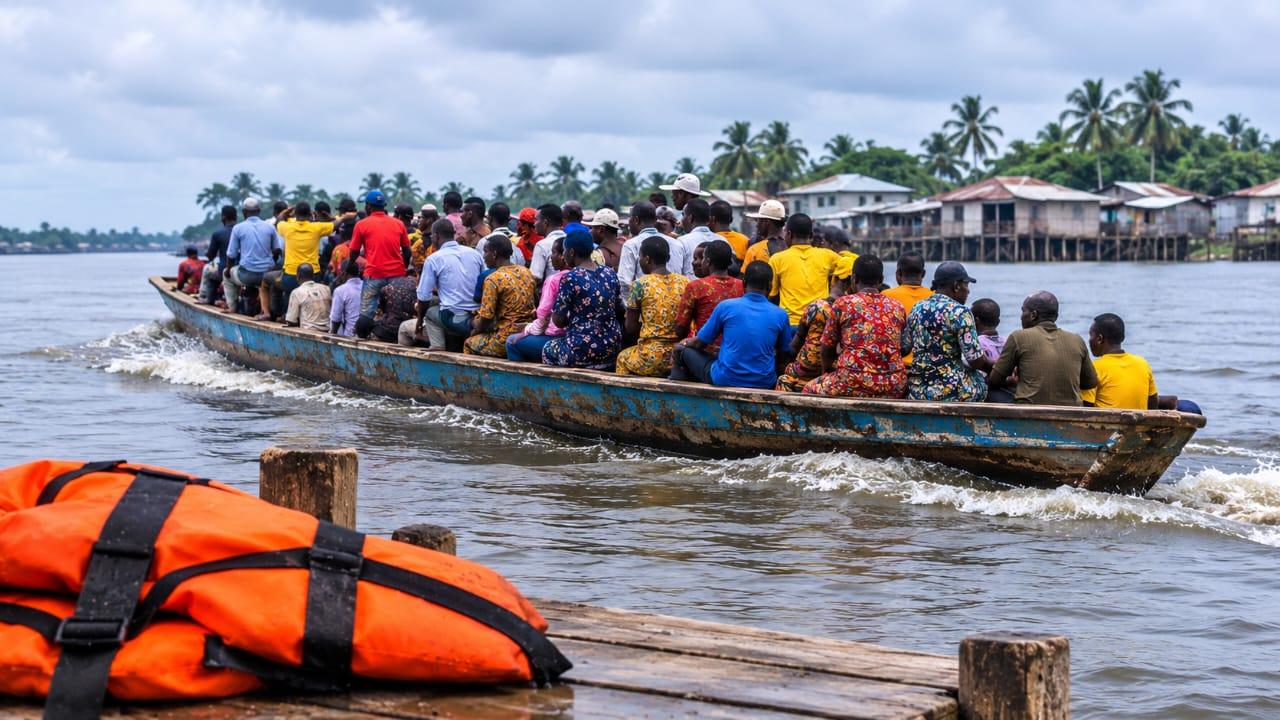
The November 20, 2026 boat mishap at Ukubie, near Oweikorogha Community in Southern Ijaw Local Government Area of Bayelsa State, has once again brought this institutional failure into focus. The wooden passenger boat, reportedly conveying mourners to a burial ceremony, capsized, claiming at least 29 lives according to subsequent reports. Preliminary accounts indicated a mechanical problem. Reports also suggested that passengers had pleaded with the operator to steer towards the shore before the boat capsized, but their request was allegedly ignored.
Following the tragedy, the Minister of Marine and Blue Economy, Adegboyega Oyetola, directed the National Inland Waterways Authority (NIWA) to investigate the immediate and remote causes of the accident. NIWA's Acting Managing Director, Umar Yusuf Girei, subsequently confirmed the deployment of an investigative team to Bayelsa to examine the circumstances, including vessel condition, life jacket use, passenger manifests and operational compliance.
These are necessary steps. But they raise a fundamental question: why does the agency responsible for regulating inland waterway transportation repeatedly find itself investigating safety failures after passengers have died?
NIWA: A REGULATOR THAT MUST ACCOUNT FOR ITS FAILURES
NIWA is not a passive stakeholder in Nigeria's inland waterway system. Its statutory responsibilities include regulating navigation, registering and licensing vessels, enforcing safety standards, conducting inspections and overseeing operations within its jurisdiction.
Its effectiveness should therefore be measured by the risks it prevents, not simply by the investigations it conducts after accidents.
A functioning regulator must know which vessels are operating, whether they are seaworthy, whether their operators are qualified, how many passengers they can safely carry and whether mandatory safety requirements are observed. It must have the operational presence and authority to stop unsafe journeys before they become fatal.
In November 2024, NIWA's then Managing Director, Bola Oyebamiji, identified human error, drug use and disregard for safety regulations as major contributors to boat accidents. He also reportedly disclosed instances of wooden boats designed for small passenger numbers carrying as many as 150 or 200 people, raising concerns about overloading and the inadequacy of penalties for violations.
That disclosure demonstrated that the authority was aware of the scale of the problem.
What changed afterwards?
How many vessels were removed from service? How many operators lost their licences? How many serious violations resulted in prosecution? How frequently are rural jetties inspected? How many enforcement officers are deployed across the waterways, and what happens when operators disregard their instructions?
A regulator cannot repeatedly identify familiar violations without demonstrating that its enforcement system can stop them.
Public education has a role, but it cannot replace regulation. Passengers should wear life jackets, operators should respect capacity limits and boat owners should maintain their vessels. However, the responsibility for enforcing statutory safety requirements rests with the relevant authorities.
THE 2025 COMMITTEE: WHERE ARE THE RESULTS?
Perhaps the most troubling aspect of Nigeria's response to boat mishaps is that the government has already undertaken a substantial review of the problem.
In January 2025, Oyetola constituted a Special Committee on the Prevention of Boat Mishaps, chaired by the then NIWA Managing Director, Bola Oyebamiji. The committee examined commercial boat operations, regulatory gaps, vessel standards and institutional capacity.
Its report, submitted to the Minister in August 2025, contained 64 recommendations, with 17 priority proposals. These included mandatory operator certification and training, a national boat design policy, increased funding for NIWA, stronger enforcement capacity, the establishment of search and rescue stations and improved safety regulation.
The recommendations addressed precisely the weaknesses that continue to feature in Nigeria's boat accident reports.
More than a year after the report was submitted, another major tragedy has occurred, prompting renewed demands for investigations and stricter enforcement.
What happened to those recommendations?
Which have been implemented? How many search and rescue stations are operational? Has a national boat design policy been adopted? What progress has been made in operator certification? Has NIWA received the additional resources recommended by the committee?
The Ministry must account for the implementation process. A committee report is not a safety intervention. Recommendations do not save lives until they become regulations, funded programmes, operational capacity and measurable enforcement.
NIWA'S LEADERSHIP AND THE QUESTION OF INSTITUTIONAL CAPACITY
NIWA's leadership structure also deserves scrutiny.
The authority's official leadership records identify Umar Yusuf Girei as Acting Managing Director and Chief Executive. He assumed office in December 2025 following Oyebamiji's departure.
An acting appointment does not automatically establish administrative failure. However, the leadership of an agency with nationwide regulatory responsibilities cannot be treated as a routine administrative arrangement while serious institutional weaknesses persist.
NIWA requires clear strategic direction, technical leadership, continuity and measurable performance targets. Its governing board equally has a responsibility to provide strategic oversight.
Who is driving the implementation of the 2025 safety recommendations? What performance targets have been established for area offices? How is enforcement monitored across riverine communities? What institutional consequences follow when safety obligations are neglected?
The public deserves more than assurances that investigations are underway. It deserves evidence that the authority is being managed towards a clearly defined safety objective.
LASWA SHOWS WHY REGULATORY PRESENCE MATTERS
The Lagos State Waterways Authority (LASWA) provides an important comparison.
Although its jurisdiction is limited to Lagos State and it does not replace NIWA's federal responsibilities, LASWA has documented operational safety measures that include regular vessel inspections, random spot checks, water guards at state owned jetties, compulsory life jackets, restrictions during adverse weather, prohibition of overloading and water patrols for emergency response.
These measures illustrate an important distinction between having safety regulations and actively enforcing them.
Lagos has not eliminated boat accidents, and LASWA's performance should not be romanticised. However, its operational approach demonstrates that safety regulation requires physical presence at departure points, inspections, monitoring and intervention when vessels fail to meet required standards.
NIWA must explain why comparable enforcement coverage remains a challenge across its much wider jurisdiction.
Its responsibility is particularly significant in riverine communities where boats are not recreational conveniences but essential transport infrastructure. In such locations, weak regulation exposes entire communities to risks they cannot easily avoid.
THE MINISTRY CANNOT ESCAPE ACCOUNTABILITY
NIWA is the operational regulator, but the Federal Ministry of Marine and Blue Economy must accept responsibility for the institutional environment in which it operates.
The Ministry provides policy direction and oversight for the authority. It must ensure that management has the resources, institutional support and performance expectations required to deliver its mandate.
Oyetola's decision to establish the 2025 special committee and order another investigation following the Bayelsa tragedy demonstrates recognition of the problem. However, ministerial leadership must be measured by implementation, not the number of committees inaugurated or investigations commissioned.
The Ministry must publish an implementation update on the 64 recommendations. It must establish what has been funded, what remains outstanding and who is responsible for delays.
Funding is central to this discussion. NIWA cannot effectively regulate an extensive network of waterways without adequate personnel, patrol boats, communications equipment, navigational aids, inspection capacity and emergency response infrastructure.
However, funding constraints cannot become a blanket defence for weak enforcement. The Ministry must disclose the resources appropriated, the amounts actually released and the expenditure directed towards safety operations. NIWA's management must equally demonstrate how available resources are being deployed.
The responsibility is shared but not interchangeable. NIWA must regulate and enforce. The Ministry must supervise, provide policy direction and demand results. State governments must provide safe local transport infrastructure and cooperate with federal regulators.
SAFER BOATS ALONE WILL NOT SOLVE THE PROBLEM
Oyetola has advocated the gradual replacement of wooden passenger boats with fibreglass or fibre reinforced plastic vessels.
Improving vessel construction and standards is important. But changing the material of a boat does not automatically make a journey safe.
A poorly maintained fibreglass vessel operated by an unqualified captain, overloaded and travelling in dangerous weather without passengers wearing life jackets, remains a threat to human life.
Nigeria needs a comprehensive safety system built around compulsory operator certification, vessel registration and inspections, enforced passenger capacity, life jackets worn throughout journeys, passenger manifests, weather monitoring, restrictions on unsafe night operations and functional search and rescue services.
Every commercial departure should have a verifiable passenger record. Every serious accident should trigger an examination of the vessel, its operator, maintenance history, safety compliance and regulatory oversight before departure.
Where negligence or regulatory violations are established, appropriate sanctions must follow.
PRIMEAXIS INSIGHT
The Bayelsa tragedy should force a more difficult conversation about the governance of Nigeria's inland waterways.
The country does not lack awareness of the causes of boat mishaps. Overloading, poor maintenance, inadequate safety equipment, unqualified operators and disregard for regulations have featured repeatedly in official warnings and investigations. The 2025 special committee went further by proposing concrete institutional and operational reforms.
What remains unclear is why these known weaknesses continue to survive.
NIWA must be held accountable for the effectiveness of its regulatory presence. The Ministry of Marine and Blue Economy must account for its oversight of the authority and the implementation of reforms it has already received. Neither institution should be allowed to substitute public assurances for measurable results.
The investigation into the Bayelsa accident must establish not only what happened aboard the boat, but also whether the vessel was registered, whether it had undergone the required inspections, whether the operator was qualified, whether safety regulations were enforced at the departure point and whether previous violations had gone unaddressed.
That is the difference between investigating an accident and investigating a regulatory failure.
Nigeria's blue economy ambitions depend on safe, reliable and accessible water transportation. Communities that depend on rivers and waterways cannot be expected to accept death as an unavoidable cost of mobility.
Every boat mishap may not be preventable. But deaths resulting from known and repeatedly ignored safety violations should never become normal.
The real test of NIWA's effectiveness is not how quickly it investigates the next boat accident. It is how many accidents its regulatory system prevents from happening.