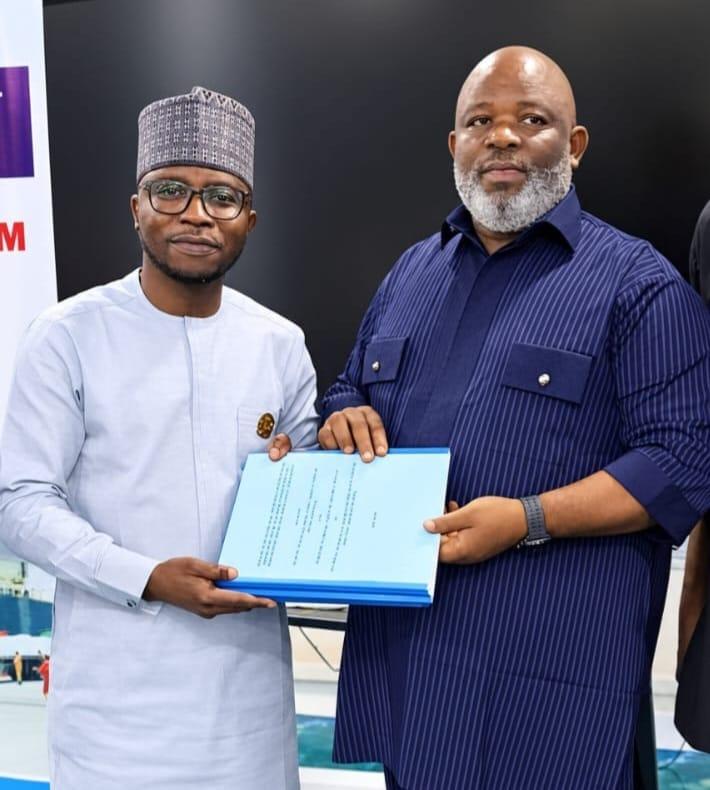

Nigeria is seeking to deepen its maritime cooperation with China through a new bilateral agreement between the Nigerian Maritime Administration and Safety Agency (NIMASA) and the China Maritime Safety Administration (China MSA), establishing a framework for collaboration across critical areas of maritime administration, safety, environmental protection and industry development.
The Memorandum of Understanding (MoU), signed in Shanghai, People's Republic of China, provides an institutional framework for both maritime administrations to strengthen technical cooperation, exchange expertise and develop practical initiatives aimed at improving their respective maritime sectors.
The agreement covers six broad areas of cooperation: maritime safety and navigation, marine environmental protection, seafarer training, certification and rights protection, marine casualty and incident investigation, maritime transportation facilitation, and maritime security.
Speaking at the signing ceremony held at the Shanghai Seafarers Assessment Model Centre, NIMASA Director General, Dr. Dayo Mobereola, described the agreement as a historic milestone in the relationship between both countries.
He emphasised that the priority must now be to translate the agreement into practical programmes and measurable benefits for the maritime industries of Nigeria and China.
Mobereola said the MoU represents a commitment to move beyond formal diplomatic engagement towards shared expertise, practical maritime cooperation and tangible industry outcomes.
He also linked the agreement to President Bola Ahmed Tinubu's commitment to strengthening Nigeria's relationship with China and advancing bilateral cooperation under the Renewed Hope Agenda. He noted that the partnership aligns with the objectives of the Federal Ministry of Marine and Blue Economy under the leadership of Adegboyega Oyetola.
China MSA Director General, Xu Wei, reaffirmed China's commitment to strengthening maritime relations with Nigeria. He acknowledged Nigeria's maritime development efforts and expressed China's willingness to support further collaboration and sustainable growth in both countries' maritime industries.
FROM BILATERAL ENGAGEMENT TO INSTITUTIONAL CAPACITY
The significance of the agreement lies in the range of responsibilities it brings within the cooperation framework.
Maritime safety and navigation, marine casualty investigation and environmental protection are central to the effectiveness of any modern maritime administration. For Nigeria, stronger institutional cooperation in these areas could support improvements in regulatory practices, technical knowledge, incident investigation and the capacity to respond to emerging maritime risks.
Seafarer training, certification and rights protection also represent an important dimension of the partnership.
Nigeria's ambition to strengthen its maritime workforce requires more than increasing the number of trained personnel. It demands internationally competitive training standards, recognised professional qualifications, continuous skills development and effective protection of seafarers' rights.
Cooperation with China MSA could create opportunities for technical exchanges, professional development and exposure to different approaches to maritime administration. However, the actual value will depend on how such opportunities are structured and made accessible to Nigerian maritime professionals and institutions.
The inclusion of maritime transportation facilitation is equally significant. Efficient maritime transportation depends on effective administration, reliable regulatory systems and coordination among the institutions responsible for shipping and maritime operations.
For Nigeria, where maritime transportation remains central to international trade and the movement of energy and other strategic commodities, improvements in administrative efficiency and technical cooperation could contribute to a more competitive operating environment.
THE IMPLEMENTATION QUESTION
While the signing represents progress in Nigeria's international maritime engagement, the more important question is what both administrations intend to deliver under the agreement.
A memorandum of understanding establishes a framework for cooperation, but it does not automatically translate into improved maritime performance. Its effectiveness will depend on the institutional arrangements, implementation priorities and resources committed to turning its provisions into operational programmes.
NIMASA will therefore need to demonstrate how the agreement will translate into specific benefits for Nigeria's maritime industry.
These include opportunities for structured technical training, exchange programmes for maritime professionals, improved capacity for marine casualty investigation, knowledge transfer in maritime safety and environmental protection, and stronger institutional mechanisms for addressing maritime security challenges.
The involvement of relevant Nigerian maritime institutions and industry stakeholders will also be important. Cooperation should extend beyond official engagements between the two administrations to ensure that the knowledge and technical capabilities developed through the partnership reach the wider maritime ecosystem.
There is also a need for clear implementation priorities and measurable outcomes. The industry should be able to identify what has changed, what capacity has been developed and how the partnership has strengthened Nigeria's maritime administration over time.
The announcement of the MoU does not yet specify an implementation timetable, dedicated funding arrangements, defined training targets or particular projects to be delivered. These are important details that will help establish the practical direction and accountability of the partnership.
PRIMEAXIS INSIGHT
Nigeria's maritime development will increasingly depend on the strength of its international partnerships, but the quality of those partnerships must be measured by their contribution to domestic capacity and industry competitiveness.
The agreement between NIMASA and China MSA offers an opportunity to strengthen Nigeria's maritime administration through technical cooperation, institutional knowledge and professional development. It also provides a platform for deeper engagement between two countries with significant interests in maritime transportation and international trade.
However, Nigeria must approach the partnership with clearly defined national priorities. Cooperation should strengthen local expertise, improve institutional performance and create opportunities for Nigerian maritime professionals rather than remain confined to diplomatic engagements and formal exchanges.
The real test will be whether this agreement produces measurable improvements in maritime safety, seafarer development, environmental protection, regulatory effectiveness and the broader competitiveness of Nigeria's maritime industry.
For NIMASA, the signing is an important starting point. Delivering on its promise will be the real measure of success.